After a month of Halloween stories exploring what could go wrong with AI, I want to give some attention to what is going right. There are real risks and plenty of unknowns ahead, but there are also people whose lives are better because someone found a useful way to apply this technology. Those benefits deserve attention, and the people making them possible deserve credit.
My work at AI Actualized focuses on helping businesses put AI to practical use. That work sits inside a much larger change in how we live, learn and care for one another. As AI becomes a greater part of everyday life, I want to understand and share the beneficial uses already taking shape, along with the reasons to be hopeful about what comes next.
That is the purpose of this gratitude series: to look closely at where AI is helping people today and appreciate the work behind it. This week’s story brings us to the foothills near Sacramento, where an early warning gave firefighters a chance to act before the first 911 call arrived.
Before the first 911 call came in about a fire near Grass Valley, firefighters were already there. An AI system had flagged a possible ignition on a camera feed at 5:19 a.m. on September 11, 2023. The first emergency call arrived at 6:01. According to ALERTCalifornia, crews kept the fire below a quarter acre.1
What happened when AI detected a fire near Grass Valley?
ALERTCalifornia reports that its Wolf Mountain 1 camera supplied the images that triggered the early alert near Grass Valley, California. The fire was near a residential area, and responders reached it before the first member of the public called 911.1
The timestamps establish a 42-minute lead over that first call. They do not establish exactly how much sooner crews arrived because of AI, or how large the fire would have become without it. The published account does not give an exact arrival time.
That distinction leaves us with a useful result we can defend: an additional means of detection was working before the usual public report arrived.
How does AI wildfire detection work in California?
The system analyzes camera images for signs of a possible fire, then directs human attention to what it finds. ALERTCalifornia describes alerts that include an estimated location and a confidence percentage, followed by review from trained personnel who confirm whether a response is needed.2
The work moves through a connected system. A camera supplies the view. Software flags something worth checking. A trained person assesses it, and fire personnel organize the response. Each handoff has a purpose; an alert becomes useful when it reaches someone who can act on it.
This also helps explain why the technology fits the job. Repeatedly examining camera feeds is a different demand from assessing a suspected ignition and deciding what resources it needs. The AI helps direct attention within that process.
Who developed ALERTCalifornia’s AI fire detection system?
UC San Diego’s ALERTCalifornia program, CAL FIRE and technology partner DigitalPath developed the fire detection AI system in 2023. ALERTCalifornia reports that the platform was used in all 21 CAL FIRE dispatch centers during its first season.3
The people maintaining the network are part of that story. UC San Diego teams handle installation, networking and research, while trained fire professionals monitor the camera network at regional command and control centers. Cameras are positioned according to practical constraints including available towers, access, funding and the terrain they can see.4
Useful AI depends on all of that physical work. A model cannot inspect an image that never reaches it, and a clear warning still needs a staffed response system at the other end.
Why does earlier wildfire detection matter around Sacramento?
Earlier detection gives responders an opportunity to assess and attack a fire while it is still small. That is the operational purpose ALERTCalifornia describes for its AI-assisted camera network.2
Grass Valley makes the point local. For Sacramento readers, the foothills are nearby communities, places where people live, work and visit. A system being used there has a relevance that a distant technology demonstration does not.
The benefit also depends on what happens after detection. Conditions, access and available resources still shape the response. Finding a fire sooner creates an opportunity to act; it does not settle the outcome.
We do not need to attach an invented evacuation story or a count of supposedly saved homes to make earlier detection matter.
What are the limits of AI wildfire detection cameras?
Camera-based detection is limited by what the cameras can see and whether the equipment and communications are working. The U.S. Government Accountability Office notes that natural barriers can hide fires, and remote locations can complicate installation, data transmission and verification.5
ALERTCalifornia also explains that cameras can go offline because of feed delays, maintenance needs or winter power-saving arrangements. Site coverage takes infrastructure, access and upkeep.4
Those limits belong in the story because they explain why cameras are one part of wildfire detection and response. The Grass Valley incident demonstrates a useful contribution in a specific event. It does not demonstrate complete coverage or a guaranteed warning before every fire.
Why be grateful for AI helping detect wildfires?
Because helping people discover a fire earlier is a practical contribution to work that carries real consequences.
My gratitude extends to the researchers and developers who built the detection system, the technicians keeping the cameras connected, the people checking the alerts and the firefighters responding. Their work is what makes the technology useful outside a demonstration.
I can appreciate that contribution without pretending to know everything that might otherwise have happened. The people doing this work deserve recognition for making an earlier warning useful.
Sources
- ALERTCalifornia: October 24, 2023 account of the Grass Valley detection and statewide rollout.
- ALERTCalifornia: Research & Technology.
- ALERTCalifornia: About the program.
- ALERTCalifornia: Frequently asked questions.
- U.S. Government Accountability Office: Wildfire Management: Technologies for Forecasting, Detection, Mitigation, and Response, June 26, 2025.
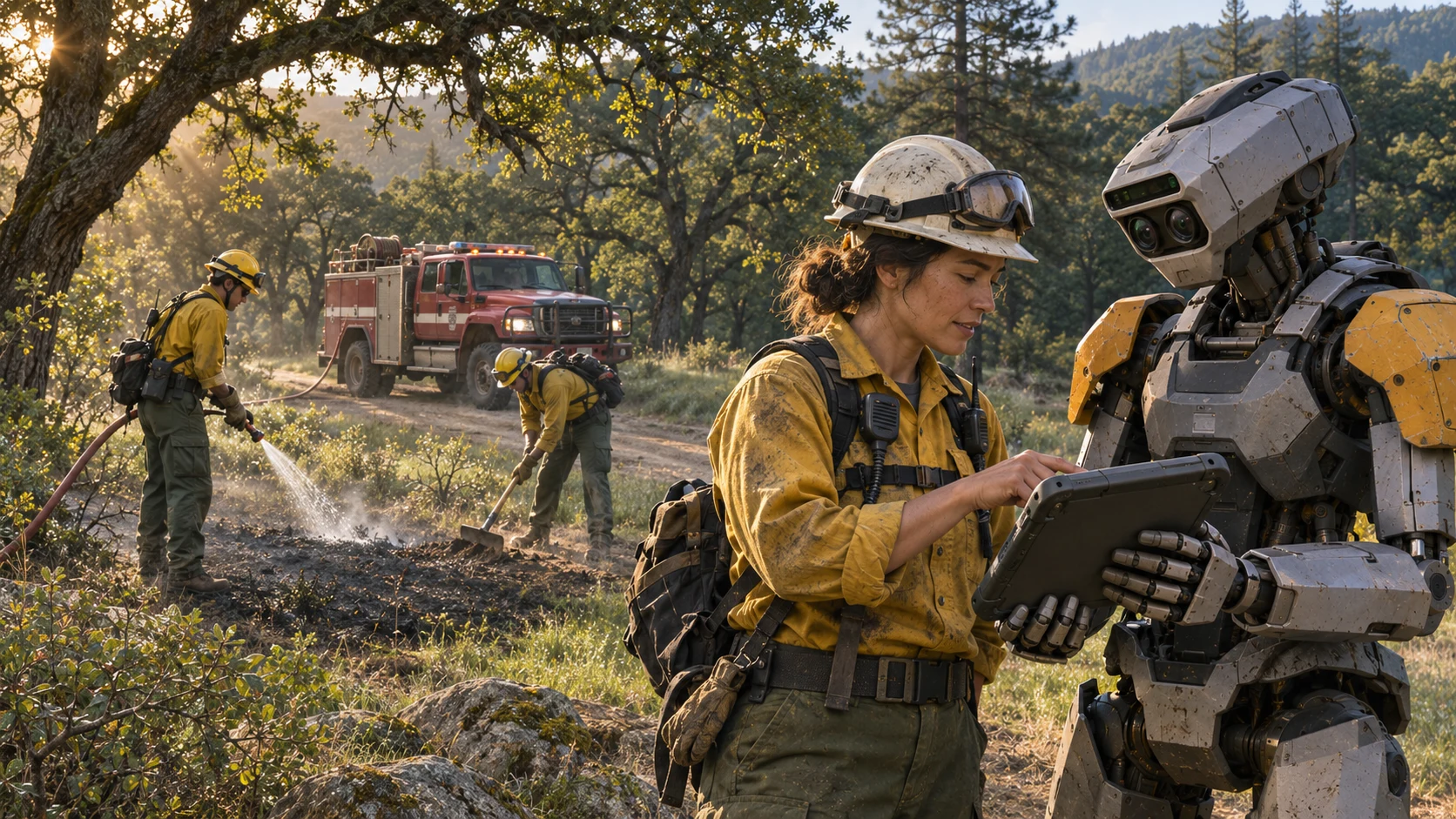
AI-generated conceptual illustration. The robot represents AI-assisted camera detection; physical robots were not part of the reported incident.